

Overview
An overhead squat is an advanced compound exercise that involves performing a squat while holding one’s arms (or a weight) directly overhead. It builds upon the fundamental bodyweight squat by significantly increasing the demand on stability, mobility, and core strength. The exercise requires excellent flexibility in the ankles, hips, thoracic spine, and shoulders, as the lifter must maintain an upright torso and the weight directly over the midfoot throughout the entire movement. Muscles worked include the quadriceps, hamstrings, and glutes in the lower body, along with substantial engagement of the core (abdominals, obliques, spinal erectors), deltoids, and triceps to stabilize the overhead load. Due to the elevated center of gravity, the overhead squat is a highly challenging exercise that not only strengthens the muscles but also significantly improves balance, coordination, and functional mobility. It is often used as a diagnostic tool to assess movement limitations and as an accessory exercise for Olympic lifts like the snatch.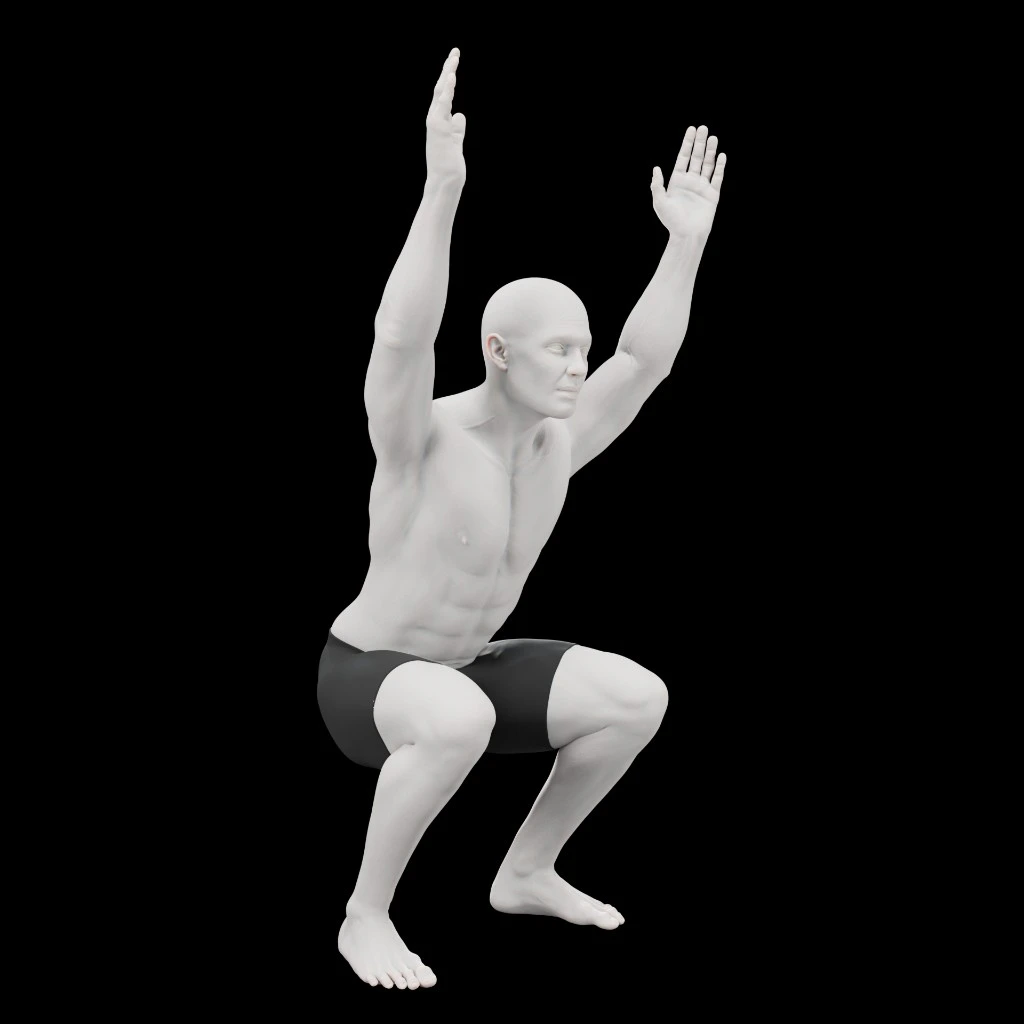
Instructions
Hold a bar, dowel, or arms directly overhead. Squat down as deep as possible while keeping the weight over the midfoot and the torso upright. Stand back up to the start position. Perform in a controlled manner; the bar and body should move as one unit.Dimensions
Required inputs for processing:- None
Output Variables
Generic Outputs
Every capture includes session metadata, standard joint angle/velocity time series, and 3D keypoint positions common to all movements. See Generic Outputs for the full list.Events
Movement Flags and General Metrics
Distance and Velocity Metrics
Joint Angle Metrics
Notes
- Kinematic data typically captured at 120Hz for Squatting